
Self-illuminating Quantum Dots
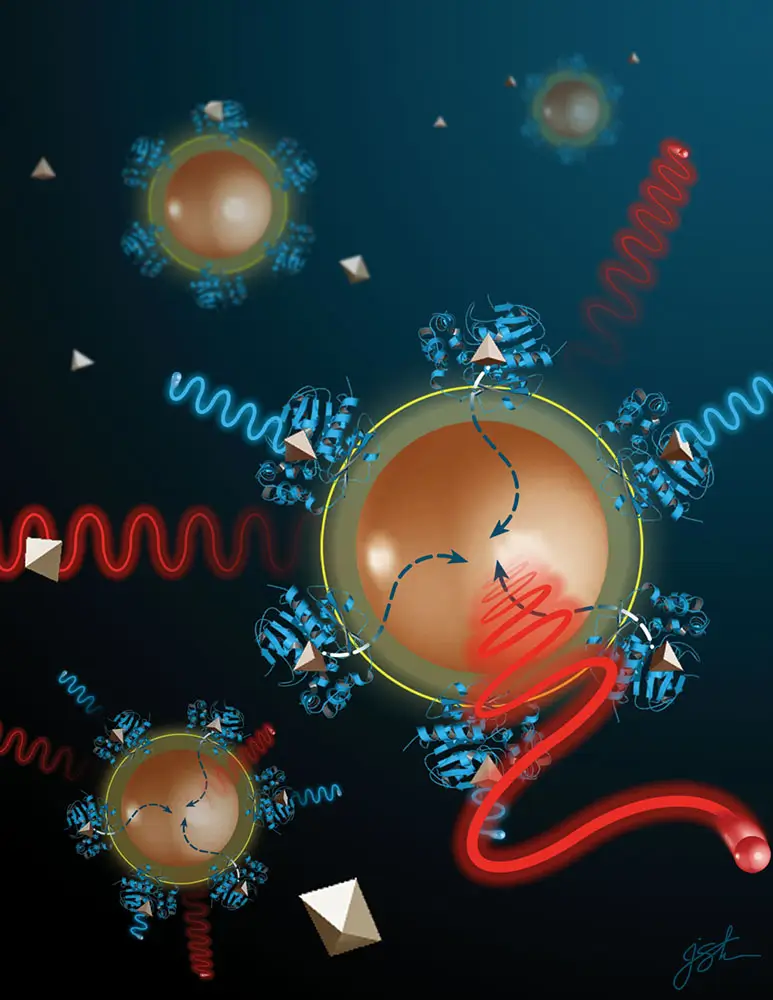
Fluorescent semiconductor quantum dots hold great potential for molecular imaging in vivo. However, the utility of existing quantum dots for in vivo imaging is limited because they require excitation from external illumination sources to fluoresce, which results in a strong autofluorescence background and a paucity of excitation light at nonsuperficial locations.
Here, I illustrate that by conjugating luciferase protein to quantum dots, bioluminescence resonance energy transfer (BRET) turns these useful fluorophores into a new class of bioluminescent probe.
Tools: Illustrator, Photoshop, Blender.